As the offshore wind sector continues to grow at pace, the vessels that build, service, and maintain wind farms play an increasingly important role in the UK’s journey to net zero. Yet these same vessels also contribute significantly to operational emissions across the offshore renewables industry. At the Offshore Renewable Energy (ORE) Catapult, we are committed to accelerating the technologies that will help transform this part of the maritime landscape—making offshore operations cleaner, smarter, and more efficient.
Through the UK Government’s Clean Maritime Demonstration Competition (CMDC) 6, we are proud to be supporting a suite of pioneering projects that are developing both energy‑efficient innovations and next‑generation clean fuels.
Driving New Efficiencies in Offshore Operations
Though maritime decarbonisation often focuses on the usage of zero emission fuels – a challenging but essential step – emissions reductions can also come from making our operations more efficient.
Two of the CMDC‑funded projects we are supporting focus on reducing fuel consumption and improving operational efficiency for offshore support vessels. Both aim to cut emissions not by changing fuels, but by enabling vessels to operate at the highest possible efficiency throughout their service life.
1. Robotic Hull‑Cleaning for Fuel Efficiency
Hull fouling—the build‑up of algae, barnacles, and marine growth—can significantly increase the drag on a vessel, reducing speed and raising fuel consumption. Traditionally, vessels require periodic dry‑docking to clean their hulls, which is both costly and carbon‑intensive.
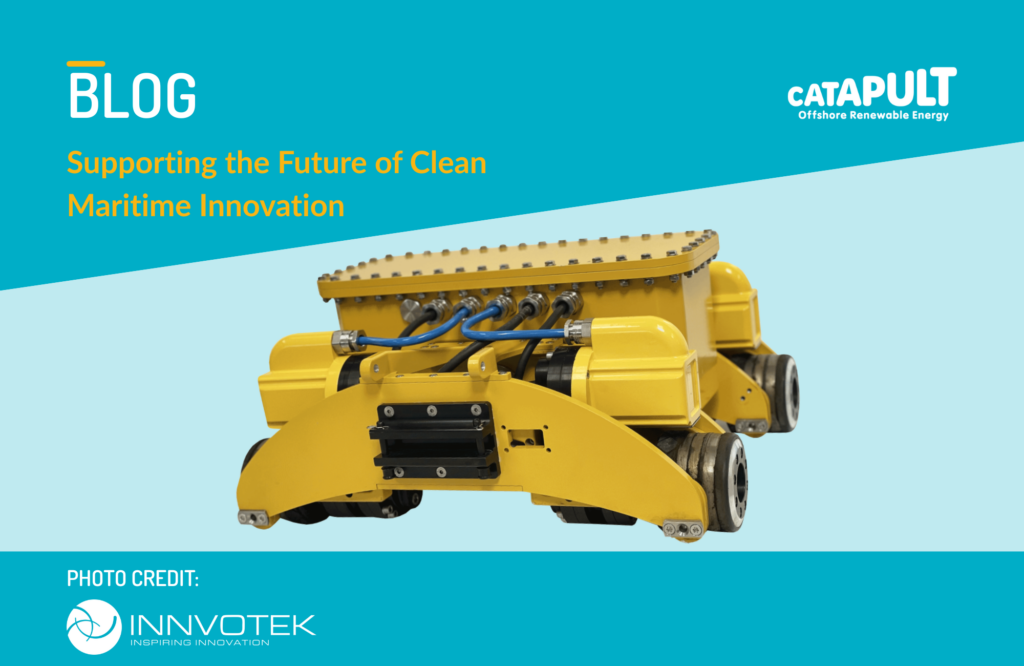
One of our supported projects is developing an autonomous robotic hull‑cleaning system that can remove this fouling while vessels remain in the water. By maintaining a clean hull surface year‑round, offshore vessels can operate more efficiently, use less fuel, and reduce the need for disruptive dry‑dock maintenance. This is a practical, scalable step toward lowering emissions across the offshore fleet.
2. AI‑Driven Predictive Maintenance for Cleaner Engines
A second project is harnessing artificial intelligence and predictive maintenance to monitor vessel engines in real time. Engine efficiency can decline as components degrade over time, or systems can drift out of optimal parameters, often long before any visible signs appear.
By using AI to detect when maintenance is required—and predicting issues before they become problems—operators can ensure engines consistently run at peak efficiency. This reduces fuel usage, cuts emissions, and helps extend the lifespan of key equipment, supporting both sustainability and operational resilience.
Both projects – examples of four such CMDC6 projects awarded to ORE Catapult currently under way with partners – actively demonstrate the calibre of innovation and fresh thinking championed by Innovate UK and the Department for Transport to further reduce greenhouse gas emissions from shipping.