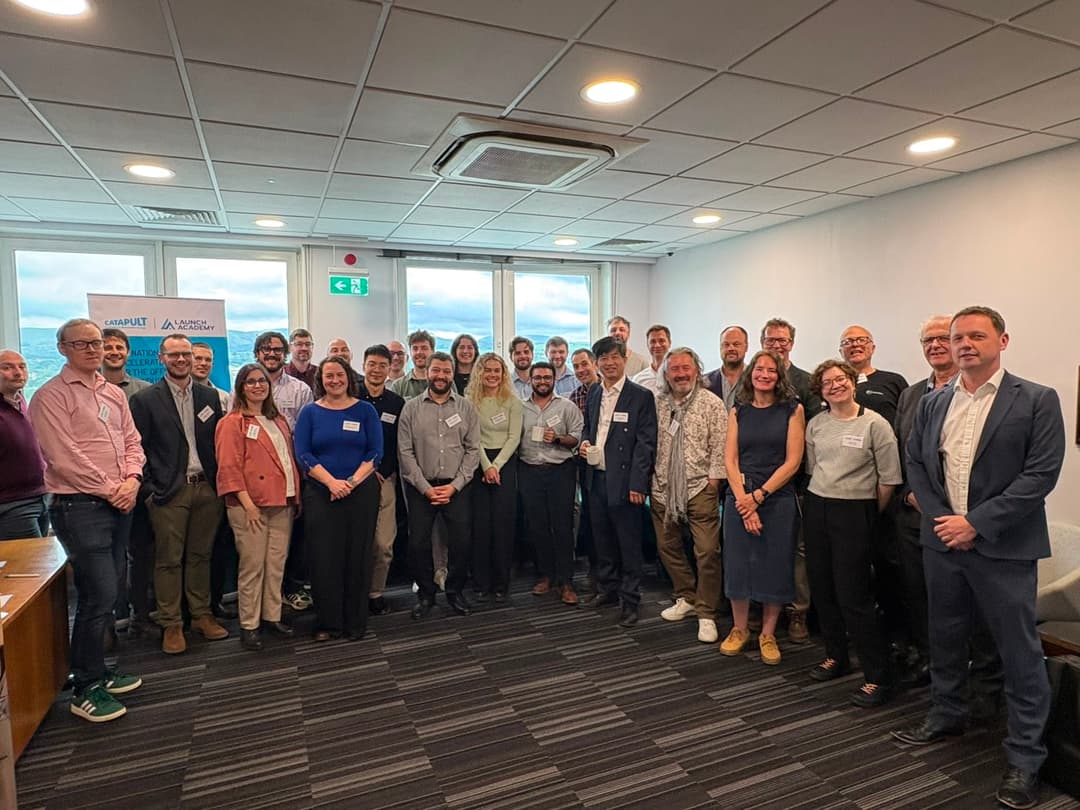
Ten companies across the UK have been chosen to fast-track technology that supports the offshore wind market as part of the Offshore Renewable Energy (ORE) Catapult’s national Launch Academy.
Since 2020, Launch Academy has supported 74 companies across its national and regional programmes, collectively raising £27.5m in private investment, £11.7m in grant funding and filing 153 patents.
The companies that have won places on the 2026 one-year award-winning programme are based in Scotland, Wales and England, with a wide variety of technologies being developed. Winning company Nature Based Ltd, based in London, is developing a living kelp forest wave attenuator – a structure designed to reduce wave impact, which would calm the sea around turbines, regenerate marine life and lower operating costs for offshore wind installations.
Harland Waterfield, CEO at Nature Based Ltd, said: “Joining the Launch Academy is a massive honour, with ORE Catapult having been a huge supporter of our work from the get-go, it is exciting to join with fellow offshore innovators. Through the programme, we hope to prepare for a demonstrator-scale deployment and continue to prove the value case for living systems engineering.”
Wind Rider Caledonia Ltd from Edinburgh, is designing a world-first passive yaw system for offshore wind turbines, where an aerofoil shaped tower self-aligns with the wind, reducing tower drag and potentially cutting the size of wind turbines.
Dr. Wangwen Zhao, Founder and Technical Director at Wind Rider Caledonia Ltd, said: “Being selected for ORE Catapult’s Launch Academy is a pivotal moment for Wind Rider. It validates not only our technology’s potential but also our commitment to transforming offshore wind economics through bold engineering. Over the next nine months, we aim to refine our commercial pathway, deepen engagement with developers and OEMs, and de-risk the final steps toward a full-scale prototype. With Launch Academy’s mentorship and industry access, we are confident we can accelerate the adoption of a simpler, lighter, and more reliable turbine support system – helping Scotland and the UK lead the next generation of offshore wind innovation.”
Ecodetect, based in Anglesey, Wales, is developing seabed and surface mounted marine monitoring and communications to detect wildlife and other objects near offshore infrastructure, using AI-driven, data processing and analytics.
David Gold, Managing Director at Ecodetect, said: “We are excited to participate in ORE Catapult’s Launch Academy programme which will enable us to accelerate our strategic expansion from ocean energy into the offshore wind sector, where we see a clear and immediate need for scalable, cost-effective environmental monitoring and compliance solutions. Launch Academy will provide us with valuable insights into the sector through access to market leaders, and programme partners, including ScottishPower, EDF, and JERA Nex bp as well as professional services and business growth support as we scale our operations.”
Launch Academy is sponsored by ScottishPower Renewables (SPR), EDF Power Solutions, and JERA Nex bp, and is an industry-recognised technology acceleration programme for early-stage companies with innovative products and services that could boost the offshore wind supply chain.
Andrew Macdonald, Director of Business Development at ORE Catapult, said: “This is the sixth year we have run Launch Academy, our flagship technology acceleration programme, and we have been very impressed by the winning companies, and look forward to supporting them as they develop their innovative technologies to support the offshore wind sector.
“As ever, we are very grateful to our industry sponsors who support the companies on their journey towards success, as we all work together to achieve the UK’s ambition of clean power by 2030.”
The Ten Successful Companies:
| Company | Location | Technology |
| CLS Wind | Edinburgh | A robotic lifting and positioning system that eliminates the need for heavy-lift cranes in onshore and offshore wind turbine installation and major component replacement operations. The technology enables wind turbine installations without speciality jack-up vessels, and in-situ offshore repairs without disconnecting and towing-to-port and is applicable to fixed-bottom and floating wind. |
| Apex Heavy Lifting | Aberdeen | A near-shore zero-radius 5,000 tonne lift concept that can be deployed at any port, support any turbine (up to 30MW) and manage any floater design. The lift would support turbine construction, turbine / floater integration and major component exchange. |
| SMRU | Fife | SMRU Consulting’s Communications Acoustic Buoy (CAB) is a real-time passive acoustic monitoring platform that delivers live environmental intelligence to support offshore wind development and operation. CAB runs automated detection algorithms directly onboard the buoy itself, transmitting marine mammal detections and underwater noise measurements live. The aim is to provide regulators and developers with auditable, robust, rapid insights to support faster, more defensible environmental decision-making, cutting costs, and enabling proportionate mitigation without weakening marine protection. |
| Wind Rider Caledonia | Edinburgh | A world-first passive yaw system for offshore wind turbines. The patented aerofoil-shaped tower self-aligns with the wind via a base-mounted bearing, eliminating the complex, failure-prone nacelle yaw drive. This breakthrough reduces tower drag and cuts tower and foundation mass, reducing costs. |
| ABMTECH | Newcastle | ECHO is an autonomous underwater vehicle (AUV) with a buoyancy engine, enabling underwater gliding and power horizontal cruising. Compared with conventional AUVs, ECHO delivers significantly higher energy efficiency, enabling continuous long-distance missions on a single charge, making it ideal for sustained environmental surveys, long-haul subsea cable route inspection and seabed data acquisition. |
| 3-Sci | Hampshire | 3-Sci develops sensors and systems for harsh environments, with particular focus on corrosion monitoring, structural health assessment and early warning of potential failures. Building on sensing and analytics developed primarily for petrochemical, oil and gas applications, 3-Sci is exploring their use in offshore wind, supporting improved inspection and maintenance planning. |
| Full Matrix | Cambridge | Full Matrix develops ultrasonic inspection and condition monitoring techniques and equipment for complex structures operating in harsh and difficult to access environments. Their aim is to develop a remote condition monitoring approach for structurally critical regions of wind turbine towers, such as the splash zone and bolted flange connections. |
| Nature Based | London | SeaShield – a living kelp-forest wave attenuator that will calm the seas around turbines – opening wider weather windows, lowering operating costs and regenerating marine life. |
| Buoyant Works | Cornwall | FlexLanding is a next-generation alternative to traditional steel boat landings used on offshore wind turbines. Manufactured from a high-performance polyurethane material, FlexLanding is impact-absorbing, modular in design, and engineered to require minimal lifetime maintenance. The technology is designed to improve crew transfer safety, increase operational efficiency, and redefine offshore wind turbine access. |
| Ecodetect | Anglesey, Wales | Development of end-to-end, seabed and surface mounted marine monitoring and communications systems for detecting wildlife and man-made objects near offshore infrastructure, using cutting-edge, AI-driven, data processing and analytics hardware and software that transform vast amounts of underwater imaging data into real-time, regulator-ready insights. The technology would replace thousands of hours of manual review with fast, accurate, and scientifically robust reporting, enabling developers to meet environmental obligations, reduce risk, and build public trust. |